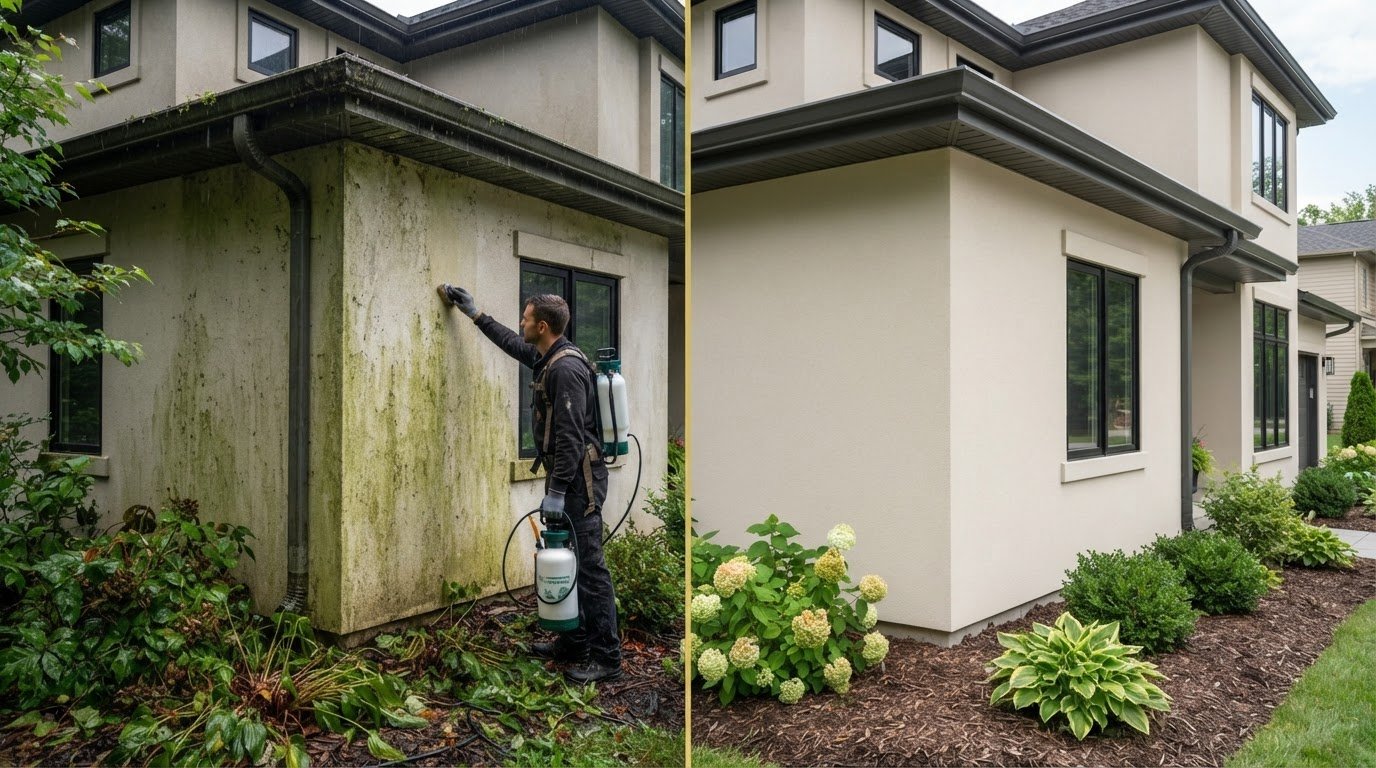
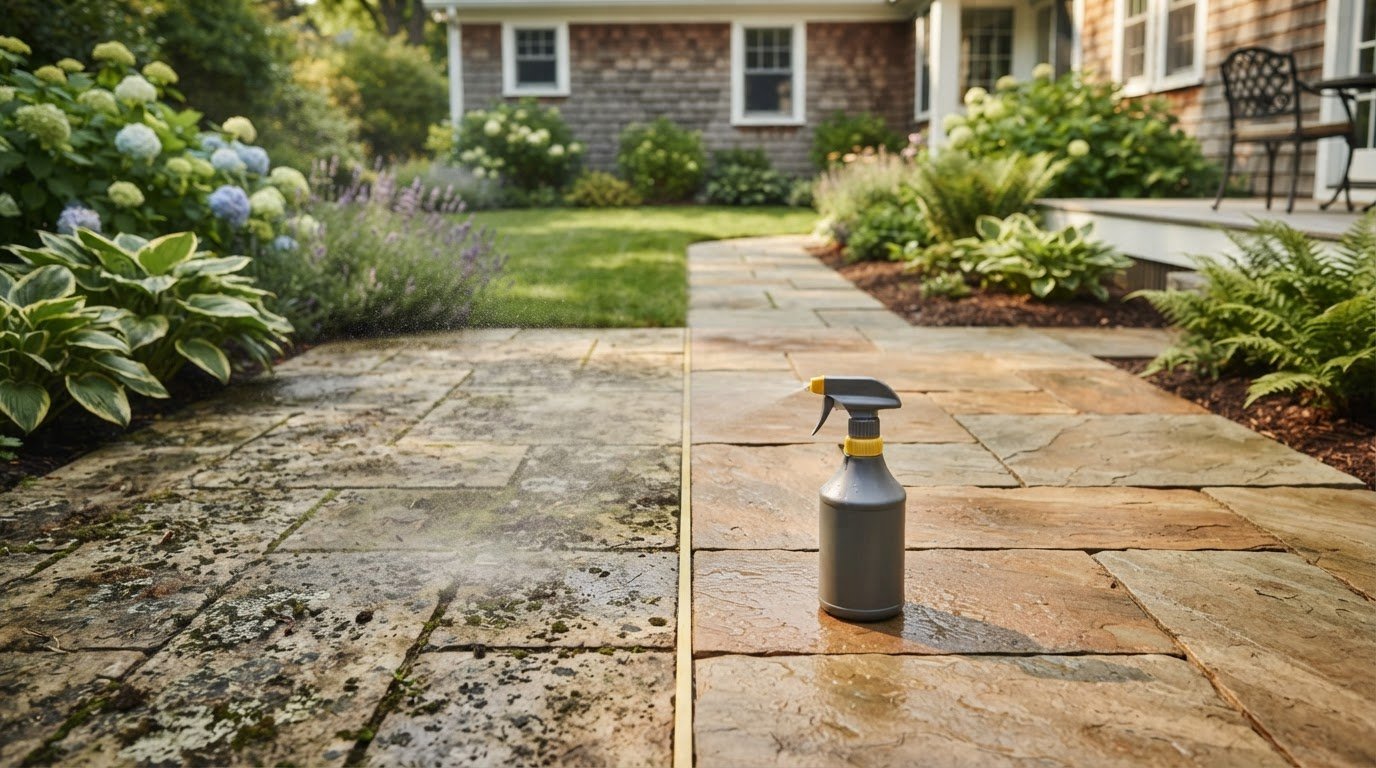
A no-scrub outdoor cleaner works on surface staining after application, reducing the need for manual scrubbing. The right formula depends on the growth or grime you’re treating and the material of your patio, path, or driveway. Follow the product directions, since application and rinsing requirements vary.
It’s frustrating to see algae, mildew, or dark marks spread across an otherwise tidy outdoor space. A spray-and-wait approach can make cleaning more manageable, but “no scrub” doesn’t mean every cleaner suits every surface or stain. Choosing carefully helps you avoid using the wrong format or ingredients for the job.
This guide explains how no-scrub outdoor cleaners work, how liquid and other formats suit different surfaces, and how ingredients and pH compare. You’ll also learn what to consider before application, when a cleaner may need time to work, and how to match a patio treatment to the staining you want to remove.
Key Takeaways
- Identify whether the marks are organic growth, dirt, or grime before choosing a treatment; the stain type and surface both matter.
- Compare concentrate, ready-to-use, and hose-end formats by how you plan to apply the cleaner and the area you need to cover.
- Spray-and-leave products work over time, so follow the product directions and allow the treatment to act as instructed.
- Use ingredient and pH information to understand how a formula is suited to its intended cleaning task and outdoor surface.
- Match a specialist patio cleaner to the problem, whether you’re tackling black spots, algae, or maintaining treated paving.
Cleaning mold, mildew, algae, dirt, and grime
Outdoor stains need different treatments: algae on paving is not the same as loose soil. Identify the mark and surface first, then choose a cleaner intended for that task.
Organic Growth Removal
Moss, mold, mildew, algae, and lichen are forms of organic growth, but they don’t look or behave alike. Moss forms visible clumps, while algae often leaves green or slippery-looking patches. Lichen can appear as firmly attached spots on stone or paving. Note where each mark appears, such as shaded joints or damp steps, before choosing a treatment.
Apply a product intended for organic staining according to its label. Avoid assuming that one application removes every type of growth immediately. Some spray-and-leave cleaners act over time, and full results may take 2-4 weeks. Check the treated area as directed, rather than scraping or scrubbing before the product’s stated process has finished.
Dirt and Grime Cleaning
Dirt and grime can include loose soil, dust, and residue carried across a patio by foot traffic or weather. A cleaner aimed at organic staining may not address every kind of buildup. Look closely at the paving: a thin layer of soil differs from dark marks embedded around slab edges or joints.
Sweep away loose debris, then assess the remaining stain. This helps distinguish surface dirt from growth attached to stone. Soil gathered beside a planter may brush away, while green discoloration in a shaded corner calls for a treatment intended for organic growth. Match the product’s stated purpose to the mark.
Keep the surface material in view as well as the stain. Natural stone, concrete paving, and joints can respond differently to cleaning products. Read the label for the intended surface and application method, then test a discreet area if the instructions call for it. Don’t combine cleaners or improvise a mixture.
- Identify the stain, such as green algae, moss, or loose soil.
- Check that the cleaner is intended for the surface.
- Follow the product label for application and treatment time.
- Assess the result after the stated waiting period.
Weather affects when you apply a treatment. The surface should be above 32 degrees during application and for approximately 5 hours afterward. Plan around that window, and follow the product label for any additional conditions. For a spray-and-leave formula, allow the stated time to work; visible change may develop over 2-4 weeks rather than immediately.
Concentrate, ready-to-use, and hose-end options
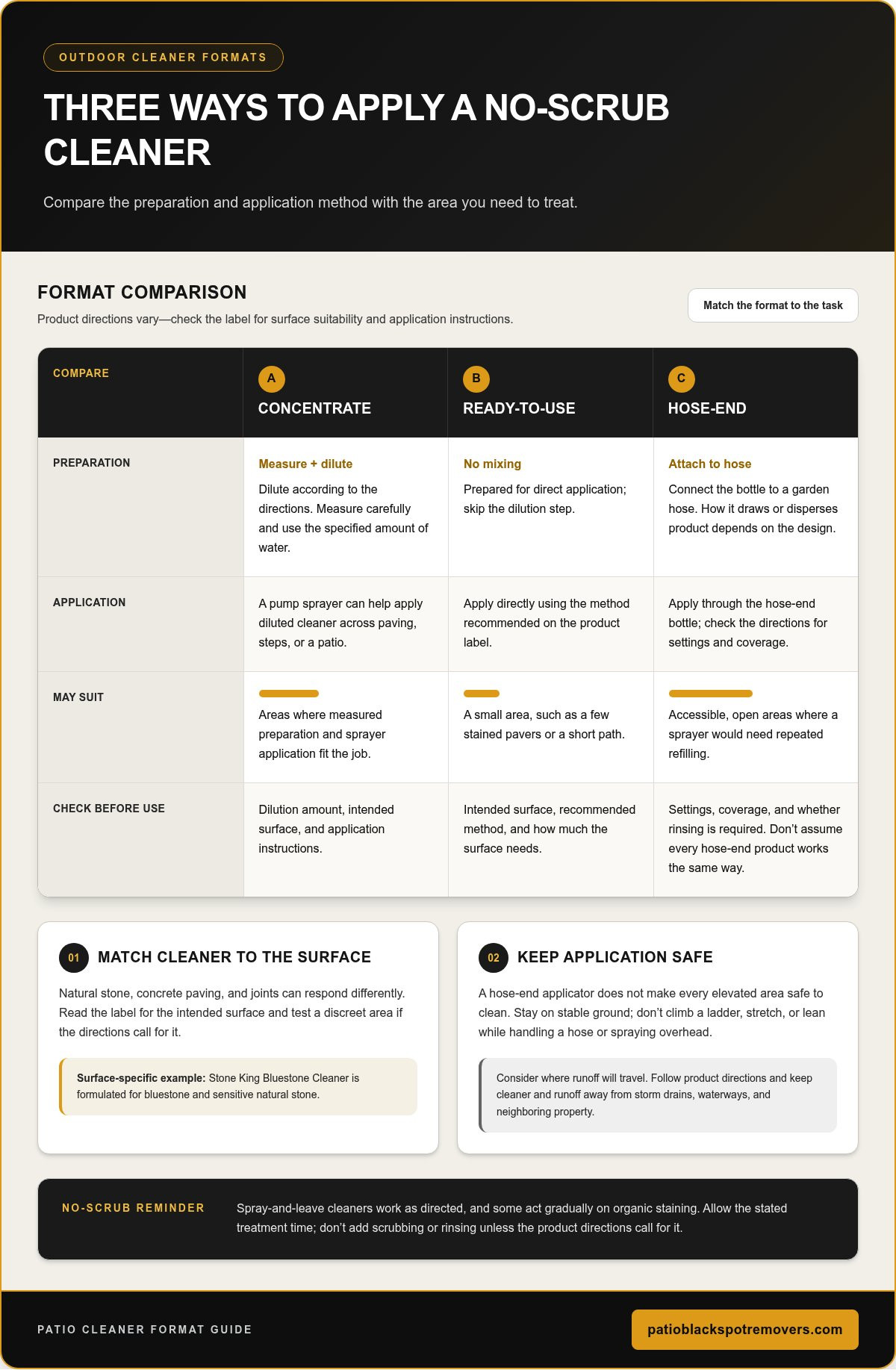
Outdoor cleaners come in different formats, each with its own preparation and application method. Match the format to the area, equipment, and product directions. A concentrate needs measuring and dilution; ready-to-use cleaner skips that step; a hose-end bottle attaches to a garden hose.
Concentrate: Dilute this format according to its directions. Measure carefully and use the specified amount of water, since guessing changes the mixture. A pump sprayer can help apply diluted cleaner across paving, steps, or a patio. Keep the label handy and follow its instructions for the surface and application.
Ready-to-use: This cleaner is prepared for direct application, so there’s no mixing. It can suit a small area, such as a few stained pavers or a short path. Apply it using the recommended method, and avoid using more than the surface needs. Store and handle the product as directed.
Hose-end: A hose-end cleaner attaches to a garden hose and draws or disperses product during application, depending on its design. It can be practical for open areas where a sprayer would need repeated refilling. Read the bottle directions for settings, coverage, and whether rinsing is required. Don’t assume every hose-end product works the same way.
For any format, check the intended surface before application. A cleaner designed for natural stone may have different directions from one intended for general paving. Stone King Bluestone Cleaner is formulated for bluestone and sensitive natural stone. Follow its product directions, and don’t improvise a dilution ratio or combine products.
Hose-end cleaner and high-elevation use
A hose-end applicator may extend your reach across a broad patio, but it doesn’t make every elevated surface safe to clean. Spray reach on a raised retaining wall or high exterior ledge depends on equipment, water pressure, and layout. Keep both feet on stable ground and don’t climb a ladder while handling a hose or spraying overhead.
Before treating an elevated area, consider where runoff will travel and whether nearby doors, plants, or other surfaces need protection. Follow the product directions for application and rinsing. If you can’t reach the target from a stable position, don’t stretch or lean to compensate.
Choose the format by the task: concentrate for measured preparation, ready-to-use for direct application, or hose-end for accessible broad coverage. For natural-stone cleaning, explore surface-specific patio cleaner options and follow the product directions for your paving.
No-scrub spray-and-leave outdoor cleaning
A spray-and-leave cleaner is applied to the stained area and left to work as directed. Unlike detergent intended for immediate rinsing, some outdoor treatments work gradually on organic staining. Assess the surface according to the product directions. Don’t add scrubbing or rinsing steps unless those directions call for them.
Are there local restrictions on outdoor cleaning runoff or chemical use in the United States? Requirements can vary by location and product. Follow the label and keep cleaner and runoff away from storm drains, waterways, and neighboring property. What safety precautions and protective gear are recommended? Read the label before use, wear the protective gear it specifies, and avoid breathing spray or getting it in your eyes or on your skin.
Prepare the area before using the sprayer. Move outdoor furniture, toys, and movable planters away from the treatment zone. Sweep loose debris so cleaner can reach the staining rather than coating leaves or soil. Protect nearby plants as directed, and consider where rain or rinse water could travel.
Apply the cleaner evenly, following its stated coverage and application method. Treat a clearly defined section of patio rather than spraying randomly across several slabs. This helps you track where the product was applied and compare areas later. Don’t let spray drift onto windows, painted surfaces, or plants unless the directions permit contact.
A motorized sprayer can reduce repeated hand pumping across a large patio or long path. An adjustable spray pattern can also help with consistent application. Use the setting recommended for the cleaner and test it on a small, inconspicuous patch. Keep the nozzle close enough to control overspray without directing concentrated spray into joints.
Motorized equipment doesn’t replace product directions or careful handling. Check that the sprayer materials suit the product, and clean the equipment as directed after application. Don’t reuse a sprayer for garden watering or another chemical unless its instructions allow it. Store the cleaner and sprayer securely, away from children and pets.
Leave the treated area undisturbed for the product’s stated working time. Don’t judge a gradual treatment by the first few hours or apply extra product simply because staining remains visible. Follow the directions for repeat applications, rinsing, and access to the surface. If weather changes during treatment, follow the product instructions.
- Read the label before preparing or spraying.
- Control overspray and keep runoff away from drains.
- Use motorized equipment only as its instructions allow.
- Wait for the stated treatment period before assessing results.
Product comparison and intended uses
Choose a cleaner by its intended surface, stain, and application format. The label tells you how to dilute, apply, and finish each treatment.
Cleaner Formats and Intended Uses
Concentrates require mixing, ready-to-use liquids apply directly, and hose-end bottles connect to a garden hose. Each format suits a different task: a ready-to-use product can simplify treating a small patch, while a hose-end applicator can cover an accessible patio. Check which surfaces and stains the product targets.
For a concentrate, measure the product and water using the stated ratio. Add them to the sprayer in the instructed order, then mix as directed. Don’t estimate the amount or assume a stronger mixture cleans better. A pump sprayer lets you apply a prepared solution across paving, while a hose-end design avoids mixing in a separate container.
Format alone doesn’t determine suitability. A product may be designed for organic growth, general dirt, or a particular stone. Compare the intended uses before choosing. If a label names natural stone, follow its instructions for stone rather than treating all paving materials as interchangeable.
Cleaning Method Effectiveness
How effective are no-scrub cleaners compared with pressure washing or scrubbing? A spray-and-leave treatment works on the staining it is formulated to address, while scrubbing provides direct mechanical action and pressure washing uses a forceful water spray. Results depend on the stain, surface, and method; gradual treatments can take 2-4 weeks to show full results.
A cleaner intended for organic staining may suit growth on paving, while loose dirt may need sweeping first. Scrubbing can target a small stubborn mark, but it takes physical effort. Pressure washing can remove surface buildup, yet force and nozzle distance matter on joints and delicate materials. Choose a method that fits the stain and surface.
Surface Compatibility
Can no-scrub outdoor cleaner damage siding, roofs, decks, or painted surfaces? Yes. A formula can harm materials it isn’t designed for, especially if misapplied or left beyond its stated treatment time. Check the product directions for each surface, including painted trim, roof materials, deck boards, and siding.
Before treating a larger area, test a discreet spot when the label recommends testing. Watch for changes in color, finish, or texture, then proceed only as directed. Protect nearby plants and surfaces from overspray, and manage runoff away from areas the label excludes. A cleaner intended for patio stone shouldn’t automatically be used on a roof or painted deck.
Before filling a sprayer, read the dilution and equipment instructions together. Use a clean container, measure accurately, and mix only what the application requires. Don’t combine cleaners or transfer a mixture into an unlabeled bottle. With a hose-end format, follow its settings rather than pre-diluting the product unless its directions say to.
Active ingredients and pH
Read the product information and pH details to understand what a cleaner is designed to do. Formulas differ, so don’t choose by the words “spray and leave” alone. Check the intended surface, target stain, dilution instructions, and safety directions before applying anything to stone, paving, or nearby landscaping.
Pure water has a pH of 7. A cleaner’s pH can help describe whether its formula is acidic or alkaline, but pH alone doesn’t identify the active ingredient or prove surface compatibility. Consider the complete label: an ingredient’s purpose, the formula’s use instructions, and its stated limits all matter when selecting a patio treatment.
A product’s stated purpose indicates what it targets. A formula intended for organic staining may suit algae on paving, while a product designed for another cleaning task may not. Read the label for named ingredients and intended uses, then match those details to the stain. Don’t infer a cleaner’s action from its color, scent, or packaging.
Are no-scrub outdoor cleaners safe for plants, pets, and people? Safety depends on the ingredients, concentration, and how the product is used. Follow the label’s protective-gear and application directions, keep people and pets away as instructed, and protect plants from unintended spray or runoff.
Use the product directions as a practical checklist:
- Confirm the label names your surface and cleaning task.
- Follow its dilution and application instructions exactly.
- Use the protective gear specified for handling and spraying.
- Keep cleaner away from plants, pets, and people as directed.
- Follow instructions for rinsing, storage, and equipment cleanup.
Don’t combine cleaners to alter pH or increase strength. Mixing products can change how they behave and create exposure risks. Use one product at a time, at its stated concentration, and keep it in its original labeled container. If a label excludes a surface, don’t apply the product there.
pH is one comparison point, not a shortcut for choosing a product. For instance, natural stone and painted surfaces may have different compatibility needs. Check the intended material and treatment method together, then test a discreet area if the label recommends testing. A “no scrub” claim doesn’t replace these checks.
For a patio cleaner suited to outdoor stone, explore patio cleaning options and compare each product’s intended use and label directions before application.
Patio Black Spot Removal: Patio Black Spot Remover
Patio Black Spot Removal INC’s Patio Black Spot Remover is designed for stubborn black-spot lichen and other organic staining on outdoor stone and paving. Choose it when black spots are the issue, rather than treating every mark as the same kind of grime.
For other needs, Stone King Bluestone Cleaner is formulated for bluestone and sensitive natural stone, Grean Boss targets green algae and mildew, and Patio Black Spot Preventer helps prevent new organic staining. Match the product to the surface and staining, then follow its directions.
To explore the patio cleaning products, visit Patio Black Spot Removal INC.
Choose your next patio-care step
Make your next step specific to the surface and the staining you want to address. A no-scrub outdoor cleaner can be convenient, but choosing by name alone isn’t enough: use the product directions to decide whether it suits your paving and cleaning task. A focused choice also helps you plan ongoing care instead of treating every outdoor mark alike.
Patio Black Spot Removal INC offers Patio Black Spot Remover, Stone King Bluestone Cleaner, and Patio Black Spot Preventer. Consider your patio’s material and maintenance needs, then follow the relevant product directions. The goal is a practical match, not more effort than the surface requires.
Ready to take the next step? Contact Patio Black Spot Removal to explore patio-care options. A clear plan can make outdoor maintenance feel manageable, and your patio is ready for a considered refresh.
Frequently Asked Questions
What is a no-scrub outdoor cleaner and how does it work?
A no-scrub outdoor cleaner treats staining through its formula rather than relying on hand abrasion. “No scrub” describes the cleaning action, not whether rinsing is needed afterward. Patio Black Spot Remover requires pressure washing after its dwell period, while Patio Black Spot Preventer is spray-and-leave and must not be washed off. Check the specific product directions before treating a patio.
What outdoor surfaces can no-scrub cleaners be used on?
Use a cleaner only on surfaces named in its directions. Patio Black Spot Removal INC products are designed for outdoor stone and paving, including patios, paths, and driveways. Natural stone examples include bluestone, sandstone, York stone, limestone, travertine, and quartzite. Stone King Bluestone Cleaner is formulated specifically for bluestone and sensitive natural stone. Don’t assume a patio product suits siding, roof shingles, or painted decking.
How do you apply a no-scrub outdoor cleaner step by step?
First, confirm the product suits the stone and wait for a dry patio and dry day. Use a 5-7 L pump-up garden sprayer, following the label’s application directions. Don’t dilute Patio Black Spot Remover or Stone King. Keep undiluted product off plants and grass. If product contacts skin, eyes, or the respiratory tract, rinse immediately with water. Follow product-specific directions for any final rinse.
How long should no-scrub outdoor cleaner sit before rinsing or rain?
There isn’t one wait time for every formula. Patio Black Spot Remover and Stone King need about 2 hours before pressure washing. Patio Black Spot Preventer and Grean Boss act over 3-5 days; Preventer should dry and must not be washed off. Apply Preventer and Grean Boss only when rain isn’t forecast for at least 48 hours. Follow the label for other products’ rinse and weather directions.
What ingredients should you look for or avoid in an outdoor cleaner?
Look for a clearly stated product purpose, ingredient information, and directions that match your surface and stain. Patio Black Spot Removal INC products are biodegradable and acid-free. Don’t assume a product is suitable just because its label mentions outdoor use. Don’t mix cleaners or spray undiluted product directly onto plants or grass, as it can scorch them. Follow the product’s handling and protective-gear instructions.