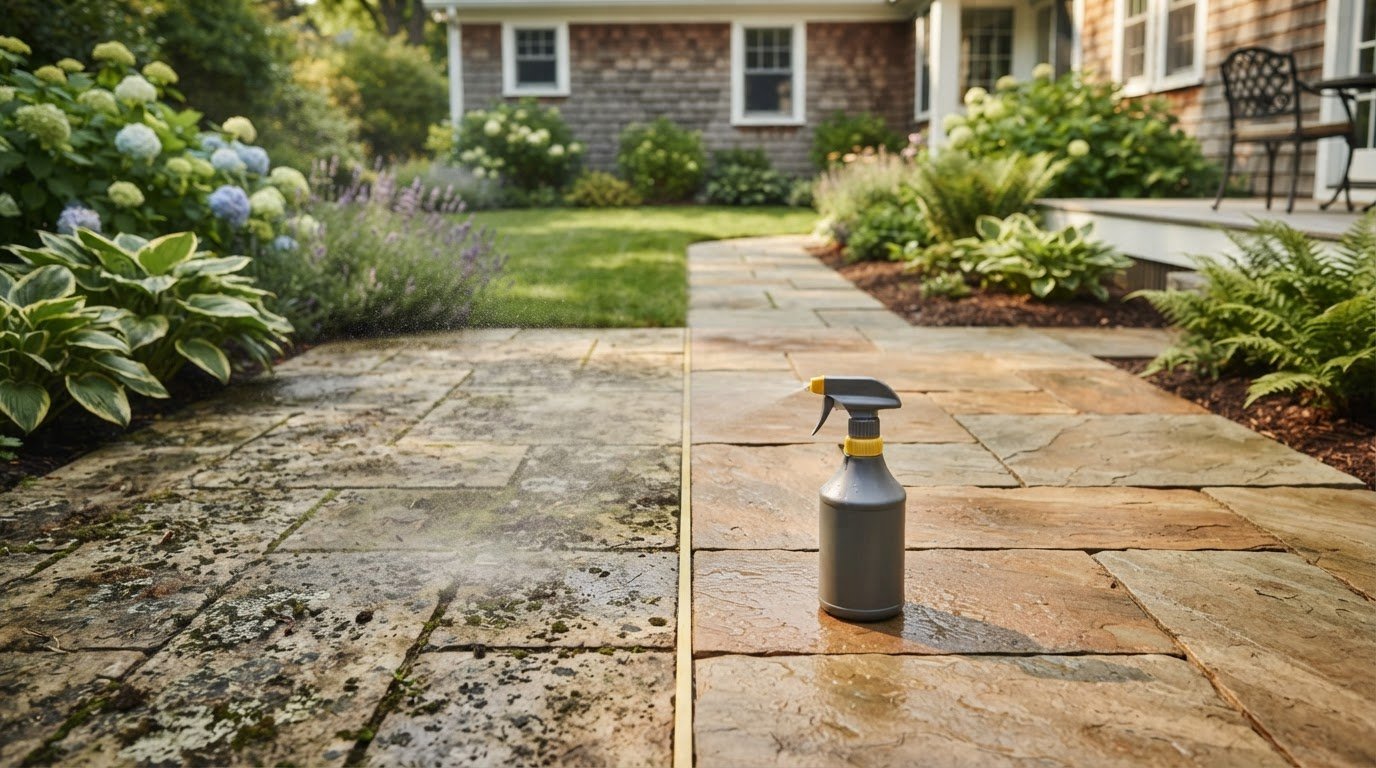
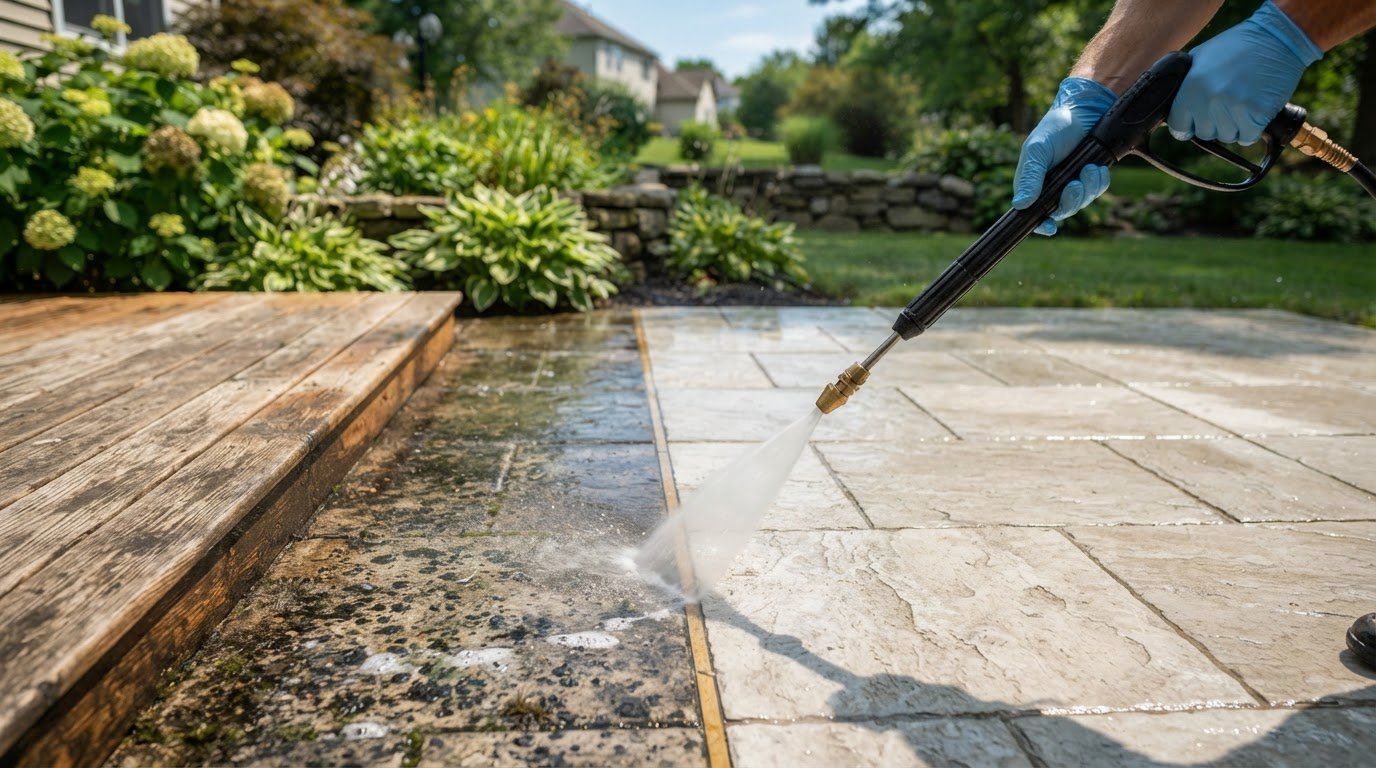
The best deck and patio cleaner depends on the surface and stain, not simply on choosing the strongest formula. Use a cleaner labeled for wood on a wood deck or fence, and one designed for stone or paving on a patio. Before staining a wood deck, clean it and let it dry.
It’s tempting to use one product on every outdoor surface, but wood, natural stone, and paving can respond differently to cleaners. Matching the product to the material helps you clean effectively without using the wrong approach.
This guide compares common cleaner types, explains how to assess surface suitability and reviews, and covers application and safety basics. Use it to choose what fits your deck, patio, or wood fence.
Key Takeaways
- Match the cleaner to both the surface and the stain; wood, stone, and paving need different considerations.
- Use consumer ratings as one clue, then weigh how well a cleaner suits your material and cleaning task.
- Check the label before applying a product, and follow its directions for coverage, dwell time, and rinsing.
- A ready-to-use gallon of liquid deck cleaner generally treats approximately 250 to 500 square feet; rinse with a pressure washer below 1,500 PSI.
- For organic staining on patios and paving, compare specialist options such as Patio Black Spot Remover and Grean Boss Algae Remover.
What Is the Best Cleaner for Wood Decks in 2026?
Choose a cleaner labeled for your deck’s wood and the stain you need to remove. For routine maintenance, match the product to the surface. Before staining, clean the boards and let the wood dry.
Light deck cleaning is recommended every 6 to 12 months. Weather exposure, shade, foot traffic, nearby trees, and visible buildup affect how soon another cleaning is needed. Grean Boss will remove green algae staining from decking within a matter of days.
Surface-Specific Deck Cleaners
Wood deck cleaners are intended for boards and common outdoor buildup, while stone and paving cleaners are made for masonry. A patio formula isn’t automatically suitable for a wood fence or deck, so check the product label for its stated surfaces. For example, clean a stained wood handrail with a wood-suitable product, not one chosen only because it works on nearby paving.
For oil or grease, choose a cleaner whose label names those stains. Identify the mark first: a greasy spill on a deck differs from algae or mildew across shaded boards. For heavy oil or cooking residues around outdoor dining areas, search for dedicated degreasing formulas. Match both the surface and the stain, rather than assuming a general-purpose cleaner will address both.
Cleaner Cost and Coverage
Deck-cleaner costs vary with the formula, package size, and intended coverage, so compare the label’s treatment area rather than price alone. A ready-to-use gallon of liquid deck cleaner generally treats approximately 250 to 500 square feet. The actual amount depends on the product and the deck area being treated.
Measure the area you plan to clean, then compare it with the product’s stated coverage. A smaller package may suit a limited area, while a larger deck may need more cleaner. Don’t assume different formulas cover the same area.
| Cleaner option | Intended surface | Best fit | Before staining |
|---|---|---|---|
| Wood deck cleaner | Wood boards | General outdoor buildup | Clean, then let wood dry |
| Wood brightener | Wood surfaces | Brightening after cleaning | Use as directed before stain |
| Oil and grease cleaner | Surfaces stated on label | Greasy marks or spills | Remove residue before staining |
| Patio or paving cleaner | Stone or paving | Outdoor masonry stains | Not a wood-deck substitute |
Match the product label to the surface and stain, then check its coverage.
Prepare Wood Before Staining
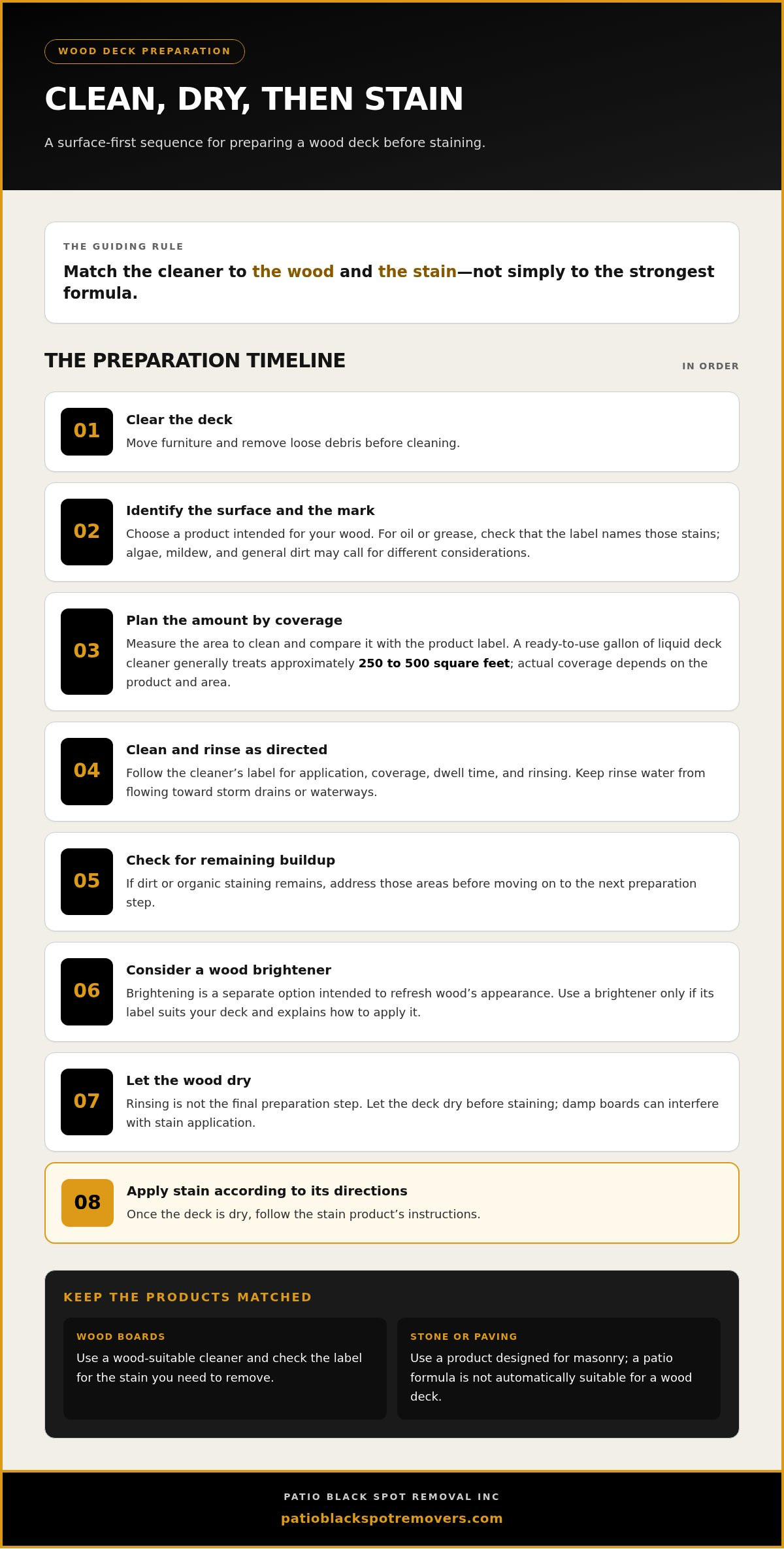
Remove furniture and loose debris, then choose a cleaner intended for the wood. Follow its label for application and rinsing. If dirt or organic staining remains, address those areas before moving on.
A wood brightener is a separate preparation option before staining. Use one only if its label suits your deck and explains how to apply it. Cleaning removes grime; brightening is intended to refresh the wood’s appearance. Neither step replaces letting the deck dry before staining.
Let the wood dry before staining. Damp boards can interfere with stain application, so rinsing isn’t the final preparation step. Once the deck is dry, apply stain according to its product directions.
Consumer ratings and reviewer scores
A high star rating can help narrow your options, but it doesn’t show whether a cleaner suits your deck. Compare reviews for the same wood type, stain, and cleaning task. A product praised for removing grime from composite boards may not address grease on natural wood. Read beyond the score to see what reviewers actually tested.
Look for reviews that name the surface and stain. “Cleaned my deck” offers little detail; “removed algae from shaded cedar boards” gives useful context. Reviews describing application, rinsing, and the final appearance can also help you judge whether a product fits your job. Specific accounts are more informative than broad praise.
Testing details matter, too. One comparative deck-cleaner test included 9 products, with 1 hour spent testing each product and 7 to 8 tests per product. Those figures describe the test process, not a promise that any cleaner will perform the same way on every deck. Use testing as one comparison point, then check that the product’s stated surface and stain match yours.
- Match the surface: Look for reviews about wood similar to your deck, rather than patio stone or paving.
- Match the stain: Separate feedback on algae, mildew, oil, and general dirt.
- Read the application details: Note whether reviewers describe scrubbing, rinsing, or repeated treatment.
- Compare specific outcomes: Prioritize comments that explain what changed on the boards.
Repeated complaints can be as useful as positive ratings. If several reviewers mention residue after rinsing, uneven application, or limited results on a particular stain, consider whether those conditions resemble your deck. One review may describe an unusual situation; a recurring detail offers a stronger basis for comparison.
Give more weight to recent, detailed reviews than to a star score without context. An account of cleaning painted wood is more relevant to a painted deck than praise for cleaning bare boards. Check whether reviewers followed the label directions, since the application method can affect the result and the value of the comparison.
Use scores to shortlist products, not to replace surface and stain matching. Compare reviewer examples with your own deck’s material and buildup, then read the label before choosing. If your cleaning decision concerns patio staining instead, explore patio cleaning options separately from wood-deck cleaners.
Deck-cleaner application and safety
Clean a deck in a controlled sequence: prepare the area, follow the product label, and rinse as directed. Coverage varies by formula and area, so use the product’s stated directions to plan how much you need.
Rules for outdoor chemical use and runoff can vary by locality. Follow the cleaner’s label and keep rinse water from flowing toward storm drains or waterways.
- Clear the deck. Move chairs, planters, cushions, and other items away from the boards. Sweep off leaves and loose debris so they don’t interfere with the cleaner.
- Protect nearby items. Move or cover objects that could be affected by splashes. Keep children and pets away from the work area while applying and rinsing the product.
- Read the label first. Confirm that the cleaner is intended for your deck’s material. Follow its stated dilution, application, dwell-time, and rinse instructions rather than guessing or mixing products.
- Apply evenly. Work in manageable sections so cleaner doesn’t dry unevenly on the boards. Use the application method specified on the product label.
- Rinse thoroughly. Remove cleaner as directed before moving to the next section. If using a pressure washer, keep the pressure below 1,500 PSI and use care to avoid damaging the wood.
- Let the surface dry. Keep foot traffic off wet boards and allow them to dry before replacing furniture or applying another treatment.
Pressure washing requires care. A narrow, forceful spray held close to wood can mark or roughen it. Keep the nozzle moving, test an inconspicuous board first, and stop if the wood fibers begin to lift. For hand rinsing, use a garden hose and work toward a clear drainage direction.
Use protective equipment as directed on the cleaner’s label. If it calls for gloves or eye protection, put them on before opening the container. Avoid splashing cleaner onto your skin or into your eyes, and close the container when it isn’t in use. Don’t combine cleaners, since mixing products can create hazards or weaken their intended action.
Plan for runoff before wetting the deck. Check where water flows, and avoid directing cleaner or rinse water toward storm drains, gardens, or neighboring surfaces. If the deck is above a patio, protect the area below from drips. This helps keep residue on the boards rather than spreading elsewhere.
After rinsing, check for suds or visible residue. Rinse again only as the label permits. Keep people off the deck until it is no longer slippery, and return furniture once the boards are dry. For homeowners looking to refresh their setup after cleaning, Zing Patio offers helpful guidance on choosing durable, pet-friendly outdoor furniture.
Outdoor cleaner for decks, patios, and wood fences
Choose an outdoor cleaner by surface first, then by the stain you need to tackle. A wood deck, stone patio, and fence may be close together but require different label checks.
Deck Cleaners
A deck cleaner is formulated for the materials named on its label, such as wood or composite boards. Its intended use may cover general grime or specific buildup, so check both the surface and stain directions. A product labeled for wood may suit a wood deck, while a patio cleaner intended for stone may not.
Wood fences share materials with some decks, but don’t assume the same cleaner suits both. Check the product label for fence use, especially if the fence is painted, stained, or weathered. A cleaner for bare wood may not suit a coated surface. Match the product to the fence finish and the buildup.
Before cleaning deck boards, identify whether the problem is dirt, algae, mildew, or grease. Each calls for a relevant product claim. For green growth, a cleaner labeled for organic stains is more appropriate than one described only for general washing. For a localized spot, test the selected cleaner in an inconspicuous area first. You can safely use the Patio Black Spot Remover on a composite deck to restore the colour and instantly remove slippery algae. Use Grean Boss on a wooden deck.
Patio Cleaners
Patio cleaners are designed for outdoor hard surfaces such as natural stone and paving slabs. Their intended stains can include organic marks like lichen, algae, and mildew. That makes them distinct from wood deck cleaners: their product directions and surface claims focus on masonry, not boards or fence pickets.
A bluestone patio calls for a cleaner labeled for suitable stone surfaces. Paving slabs may also need a product intended for outdoor stone. Don’t choose by the word “patio” alone; confirm the material and stain claims. A stone cleaner may not suit wood, even if the discoloration looks similar.
Use the visible stain to narrow your options. Black spotting on paving, green algae on a shaded patio, and mildew on a fence are different cleaning tasks. Identify the surface and stain, then compare them with the product label. This helps avoid using a masonry cleaner on wood or a deck formula on stone.
If your property has several outdoor materials, treat each area as a separate job. Clean a wood deck with a product labeled for that wood, and choose a patio cleaner for stone or paving. For a wood fence, follow directions suited to its finish. Use one product across these surfaces only if its directions explicitly allow it.
Deck-cleaner types and intended surfaces
The best cleaner depends on the surface and stain, not on a single all-purpose label. For wood, composite, concrete, or stone, choose a product whose directions name the material and the buildup you need to remove.
Cleaner categories often reflect a surface or cleaning task. Wood cleaners, composite-safe products, and stone or concrete cleaners aren’t automatically interchangeable. Start with the material, then identify whether you’re tackling dirt, algae, mildew, or grease. This two-part match helps you choose more carefully than broad labels such as “outdoor cleaner” alone.
- Wood: Select a cleaner that identifies wood decks or fences on its label. Check whether it addresses the visible issue, such as grime or organic growth.
- Composite: Look for composite decking in the stated uses. A product intended for natural wood isn’t automatically right for manufactured boards.
- Concrete: Choose a formula labeled for concrete patios or walks. A concrete surface differs from wood in texture and porosity.
- Stone: Match the cleaner to the stone type and outdoor use. Natural stone, including bluestone, calls for surface-specific directions.
These categories differ in their intended surfaces, not just their packaging. A stone cleaner may suit a paved patio but not a timber deck; a deck product may suit boards but not a concrete path. If a patio combines stone slabs with a wooden border, treat each section as a separate cleaning job.
Use the stain as your next filter. Green growth on a shaded surface points to a cleaner labeled for algae or similar organic buildup. A dark mark may need a product whose directions address that stain. Grease near an outdoor grill is another distinct task. Don’t assume an exterior cleaner handles every mark.
Use this quick decision process before buying:
- Identify the surface, such as composite boards or concrete paving.
- Name the visible stain, such as algae, mildew, dirt, or grease.
- Read the cleaner’s stated surfaces and stain claims.
- Follow its application directions on the relevant area.
If the label doesn’t include your material, choose a product that does. For surfaces listed on the label, test an inconspicuous area first, especially where the finish or color matters. Separate products may be the clearest choice for a mixed-material outdoor space. For stone paving, explore patio-cleaning options suited to outdoor surfaces.
Patio Black Spot Removal INC: Patio Black Spot Remover
Patio Black Spot Removal INC offers Patio Black Spot Remover for stubborn black staining on outdoor paving. Its patio cleaners are designed for natural stone and paving slabs, where lichen, algae, and mildew can dull the surface. Match the cleaner to the stone and buildup, then follow its product directions.
For other patio-care needs, choose a cleaner suited to the surface and type of staining. Patio Black Spot Preventer helps prevent new organic staining after cleaning. These products are for outdoor stone and paving, so match them to the surface.
For stone or paved areas that need a dedicated cleaner, contact Patio Black Spot Removal INC or visit patioblackspotremovers.com.
Make your next cleaning decision easier
Before your next outdoor cleanup, note the materials around your home and the stains that return most often. A short maintenance note for your deck, patio, and fence can help you choose a suitable deck and patio cleaner without treating every surface alike. Keep the product label handy to guide your next application. Reach out to the team at patioblackspotremovers.com for further guidance
For stone or paved areas that need a dedicated cleaner, Patio Black Spot Removal INC offers products tailored to outdoor surfaces. Choose one that suits your patio material and cleaning task, then follow its directions.
Explore patio cleaning products and take the next step toward a cleaner, more inviting outdoor space.
Frequently Asked Questions
How do deck and patio cleaners compare: oxygen bleach, chlorine bleach, and pressure-washer solutions?
Compare the cleaner’s intended surface and directions rather than choosing by ingredient name alone. Oxygen bleach and chlorine bleach are categories of chemical cleaners; pressure-washer solutions are products intended for use with equipment. A pressure washer itself isn’t a cleaning formula. Check that the product names your deck material, and follow its directions for dilution, application, and rinsing. Don’t mix products or assume one formula suits every surface.
What are the best-rated deck and patio cleaners in the United States?
There isn’t one top-rated choice for every deck and patio. The best fit depends on the material and stain: a wood cleaner may not suit stone paving, and a product targeting algae may not address grease. Compare reviews describing a similar surface and task. Feedback about removing algae from stone, for example, is more useful for a similar patio than a general star score.
Can deck and patio cleaner damage plants, pets, wood, composite decking, or nearby surfaces?
Yes, a cleaner can cause problems if it reaches an incompatible surface or is used against its directions. Match the label to wood, composite, or stone, and protect nearby plants from overspray. Patio Black Spot Removal products are biodegradable and acid-free, but don’t spray undiluted product directly onto plants or grass. Keep runoff out of fish ponds. Follow each product’s directions about pets and when the area can be used again.
What protective equipment and safety precautions should you use when applying deck cleaner?
Follow the product label’s safety instructions. When applying products from Patio Black Spot Removal INC, wear old clothing and waterproof boots. Avoid contact with skin, eyes, or the respiratory tract. If direct contact occurs, rinse immediately with water. Keep pets away until the treated area is dry or, where directed, thoroughly rinsed. Protect plants from direct spray and prevent runoff from entering fish ponds.
Do deck and patio cleaners need to be rinsed, and how long should they sit before rinsing?
Follow the specific product directions because rinse requirements differ. Patio Black Spot Remover and Bluestone Cleaner Stone King sit for approximately 2 hours before pressure washing. Patio Black Spot Preventer is spray-and-leave: allow it to dry, and don’t wash it off or pressure wash afterward. Allow the cleaner time to work according to its product directions before rinsing. Apply products only to a dry surface and follow their label instructions.