
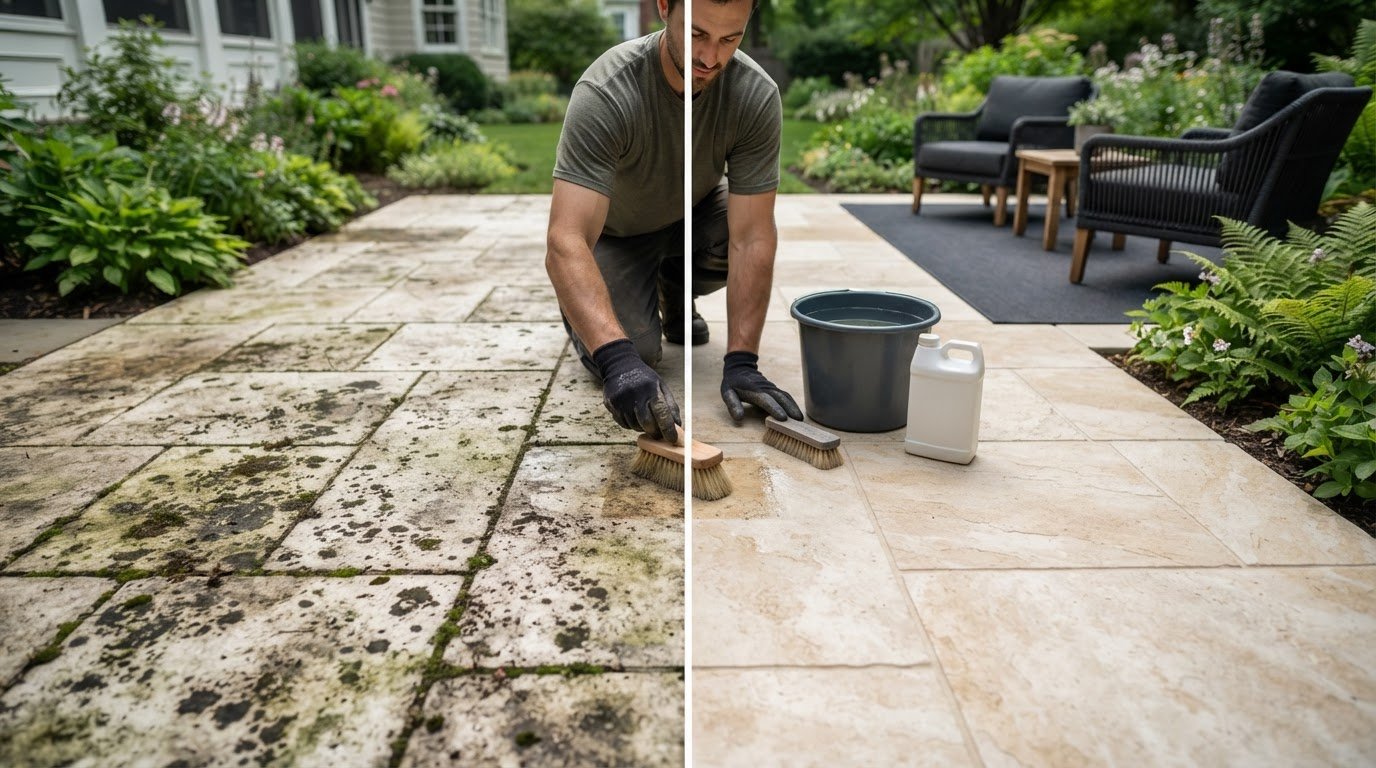
Limestone cleaning starts with identifying the surface and the likely cause of the soiling. A dark mark could be dirt, algae, lichen, mildew, or another stain, and guessing can lead to unnecessary scrubbing or stone damage. Use the gentlest suitable method, then reassess before moving to a stronger treatment.
Advice about household cleaners and pressure washing can seem conflicting. Limestone reacts to acids, so common options such as vinegar can etch the surface, while excessive pressure may wear or damage the stone. A cautious approach helps protect your paving while tackling the soiling.
In this guide, you’ll learn how to assess likely stains, compare gentle cleaning with stronger methods, and choose a practical treatment for outdoor limestone. You’ll also find a safe testing process, signs that mean you should pause, and simple maintenance steps to help care for your paving.
Key Takeaways
- For limestone cleaning, match the approach to both the stone and the likely cause of the soiling, not just the mark’s colour.
- Compare gentle water and brushing, a suitable stone cleaner, and pressure washing by their likely use and surface risk.
- Use a cautious sequence: clear loose debris, follow cleaner directions, and test a discreet area before treating the full surface.
- Choose products by their stated use: black spot treatments address black spots, Grean Boss Algae Remover is for algae, and Stone King is for bluestone and sensitive natural stone.
- Understand the difference between cleaning and other stone-care work, such as honing or polishing.
Limestone Cleaning Starts with Identifying the Stone and the Stain
Limestone is a natural stone formed mainly from calcium carbonate. Its mineral composition affects how it responds to cleaning products and tools, so a method that suits one patio material may be unsuitable for another. Calcium carbonate also appears in limescale, primarily calcium carbonate, but the presence of a similar mineral does not make every surface or deposit identical.
Start with two questions: what is the paving, and what might be on it? Limestone cleaning is safer when you consider both before choosing a product. The finish matters too. A textured or weathered surface can hold soil differently from a smoother one, and worn areas may be more vulnerable to aggressive scrubbing. Appearance offers clues, but it cannot confirm the stone or stain on its own.
How can you tell whether the patio is limestone?
Check installation records, invoices, packaging, or original product details if available. These are more dependable than identifying stone by colour alone. Limestone varies in shade, markings, and texture, and outdoor exposure can change its appearance over time. A pale colour or visible fossils may offer clues, but neither proves the material’s identity.
Compare the paving with any labelled spare pieces or product documentation. Note the finish and condition too: is it rough, smooth, uneven, or visibly worn? Limestone, bluestone, concrete, and other paving materials do not necessarily share a cleaning method. If you cannot identify the material, do not treat a test patch as proof of its identity. Establish what the surface is before selecting a cleaner.
What might dark marks on limestone indicate?
A dark patch could be environmental soil, organic growth such as algae, mildew, or lichen, or another type of surface staining. Look at its pattern and location. Is it concentrated in damp or shaded spots, spread along a walkway, or isolated around a spill? These observations can help narrow the possibilities, but they cannot confirm the cause by sight alone.
Weathering can make different marks look alike. Greenish areas may suggest growth, while black marks can have several causes. Neither colour is conclusive. Avoid choosing a chemical treatment just because a stain looks black or green. A product intended for one kind of soiling may not suit another, and the stone must also be compatible with the cleaner.
- Record the pattern: note whether marks are isolated, widespread, or concentrated in particular areas.
- Observe the setting: consider shade, dampness, nearby soil, and regular foot traffic.
- Hold off on treatment: do not apply a stronger cleaner until you have considered both the likely soil and the paving material.
You do not need to identify every stain with certainty at this stage. These checks help reduce guesswork and guide your next step based on the stone’s type, finish, and condition.
Why Limestone Cleaning Needs Care with Acids and Strong Pressure
Limestone can look solid, but the wrong cleaner or an overly forceful wash may alter its surface. An aggressive treatment might remove visible grime while leaving etching, roughness, or an uneven appearance. The aim is to remove the soiling without stripping or wearing the stone.
Begin limestone cleaning with the least aggressive method that suits the suspected soil and the condition of the stone. Distinguish a gentle rinse from pressure washing, and check a cleaner’s intended use rather than assuming a familiar household or masonry product is safe for every surface.
Why should you avoid acidic cleaners on limestone?
Limestone contains calcium carbonate, which can react with acids. That reaction may dull or etch the surface, leaving a mark that looks different from ordinary dirt. Avoid acidic cleaners on limestone, and check product labels and material guidance before use.
Vinegar and lemon-based mixtures are common household examples, but “mild” does not mean harmless to acid-sensitive stone. A cleaner intended for masonry is not automatically suitable for limestone either. If the product directions do not clearly support the stone and task, do not apply it to the paving.
Is pressure washing suitable for limestone paving?
A pressure washer can force water into joints and expose a vulnerable or weathered surface to more force than intended. There is no single pressure, nozzle, or distance that is universally safe for every limestone type and condition.
Rinsing loose soil with a gentle flow of water is different from using a pressure washer to remove a stubborn stain. Start with the gentler option. For broader advice about equipment and pressure-washing considerations, see this patio power washing guide, but do not assume general patio guidance overrides the needs of limestone.
Before considering powered equipment, inspect the paving. Crumbling edges, worn patches, open joints, or a visibly weathered finish are reasons for extra caution. If water alone does not lift the soil, increasing the force is not automatically the right next step. A cleaner selected for the stone and type of soiling may be more appropriate, provided its directions support that use.
- Skip improvised chemistry: do not mix cleaning products or try an acidic household remedy.
- Keep rinsing gentle: remove loose debris without treating a forceful jet as a routine rinse.
- Pause if the surface changes: stop if cleaning reveals unexpected dullness, roughness, or colour change.
For other outdoor stone-care needs, browse the outdoor stone cleaning and treatment range. Match a product to its stated use rather than choosing by the stain’s colour alone.
Comparing Limestone Cleaning Methods for Outdoor Stains
Once you have considered the paving and likely soil, compare methods by how much intervention they require. Loose dust and surface grime call for a different approach from a persistent mark. A method that suits one stone or stain is not automatically right for another.
Choose a limestone cleaning method by matching the stone, the suspected stain, and the product directions, then use the least forceful suitable option. An organic stain remover is not automatically suitable for every natural stone. Check its stated use against the paving material and the type of soiling before applying it.
| Method | Likely use | Main limitation | Relative surface risk |
|---|---|---|---|
| Gentle water and brushing | Loose debris and light surface grime | May not address persistent staining | Low when rinsing gently and brushing softly; friction can still affect a vulnerable finish |
| Suitable stone cleaner | Soiling addressed by a product labelled for the stone and task | Compatibility and directions vary by product | Depends on the cleaner and how it is used; a discreet test helps assess the surface |
| Controlled pressure washing | Situations where water flow is being considered for outdoor paving | No universal setting suits every stone and condition | Greater potential for damage if pressure or technique is unsuitable |
When is gentle washing and brushing a sensible first step?
Remove loose leaves, grit, and other debris before applying any cleaning treatment. Rinse gently, then use a suitable fiber brush with light strokes rather than forceful scrubbing. Mild detergent and water are one possible cleaning approach, but the method is not a guarantee for every limestone finish or condition. Test a small, discreet area before using it more broadly.
When might a stone cleaner be the better comparison?
A cleaner may be worth considering when water and gentle brushing are not suited to the identified soil. Compare the product’s stated stone compatibility and intended use, follow its directions, and test discreetly. Stone King is a targeted cleaner for bluestone and sensitive natural stone. Check product directions for the material and task rather than assuming that a cleaner for another stone is suitable for limestone.
Products aimed at organic staining still need to be matched to the paving. An algae-focused treatment and a black spot treatment have different stated purposes, and neither should be selected by colour alone. If you are considering powered equipment, the patio power washing guide offers broader considerations, but not a universal limestone pressure setting.
Keep the decision simple: use gentle water and brushing for loose soil, consider a stone cleaner only when its directions fit the material and task, and treat pressure washing as the more forceful option. For outdoor stone cleaners and treatments, compare products by their stated use before choosing what to apply.
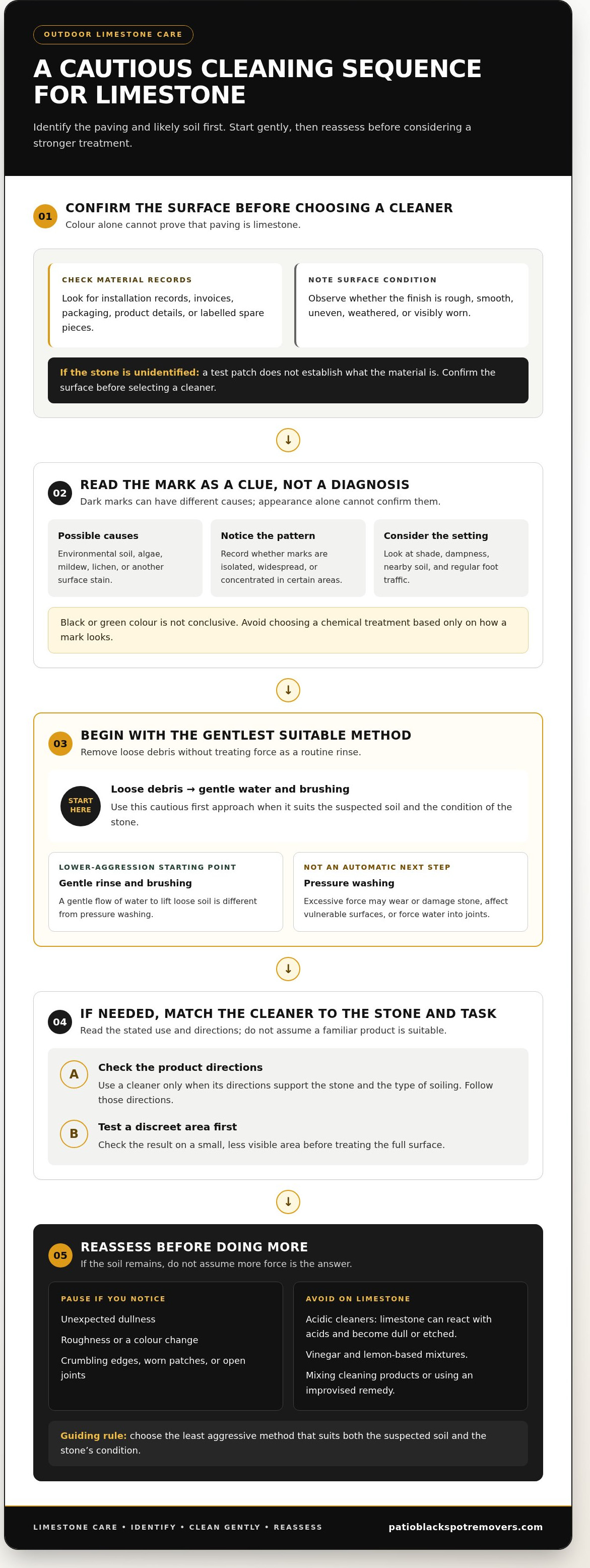
How to Clean Outdoor Limestone: A Cautious Step-by-Step Process
A steady process makes limestone cleaning easier to control. Work in stages, and do not move to a stronger treatment just because a mark does not disappear at once. If you cannot identify the paving or the cleaner’s directions do not fit the surface, pause before applying it. You can send images of your patio to the Patio Black Spot Removal Inc team for advice at this point.
What should you do before cleaning limestone?
Before starting, photograph the area and note the visible marks, finish, and any existing chips, worn patches, or discolouration. This gives you a useful comparison after testing and helps distinguish a pre-existing change from a cleaning reaction. Then prepare the area without disturbing the stone.
- Confirm the material. Review installation records or product details where available. Do not rely on colour alone to identify limestone.
- Clear loose debris. Remove leaves, grit, and surface dust with a soft brush or another gentle, non-abrasive approach. Avoid grinding grit into the paving as you sweep.
- Protect nearby areas. Check the cleaner’s label for instructions about protecting plants and surrounding materials. Follow those directions before applying anything.
- Choose a compatible treatment. Use a cleaner only when its directions fit the identified stone and cleaning task. A product intended for another material or type of soiling is not automatically suitable.
How should you apply and assess a cleaning treatment?
A small test helps you spot an unexpected change before treating a wider area. Choose a discreet patch of the same paving, and use the product exactly as directed. Do not add a dwell time, dilute the cleaner, or combine it with another treatment unless the label specifically instructs you to do so.
- Test discreetly. Apply the cleaner to a small area, following its label for application and handling.
- Complete the instructed process. Rinse the test patch or leave the product in place as its directions specify. Do not guess at the next step.
- Assess the result. Compare the patch with your before photograph. Look for unexpected colour change, dullness, roughness, or other surface alteration, as well as any change in the mark.
- Proceed only if the test is acceptable. If the surface appears unchanged and the directions support broader use, continue carefully as instructed. Keep the treatment within its stated use.
Stop if the stone reacts, the stain persists, or you are unsure what a surface change means. Do not respond by increasing pressure, scrubbing harder, or applying a second chemical treatment. A stubborn mark may need a different diagnosis, while an unexpected reaction is a reason to prevent further treatment until the cause is clearer.
For outdoor stone treatments, use the product’s stated purpose as your guide and review the available stone-care products before choosing what to apply.
Choose a Stone-Matched Cleaner and Maintain Limestone Carefully
Before choosing a treatment, use a simple framework: identify the paving, consider the likely source of the soiling, read the product directions, and test a discreet area. A cleaner aimed at organic growth is not automatically suitable for every natural stone. Match the product to both its stated purpose and the surface you are treating.
Which outdoor stone-cleaning product fits the problem?
Product names and descriptions can help narrow the options, but the directions should guide your choice for a particular stone. Patio Black Spot Remover is designed for stubborn black lichen spots and organic staining but will also remove green Algae. Grean Boss Algae Remover is for lighter green algae staining where black spots are not present. Bluestone Cleaner Stone King is formulated for bluestone and sensitive natural stone. Match each product to the material and task stated in its directions.
Use the visible mark as a clue, not the only deciding factor. If you suspect black lichen, compare the problem with the black spot treatment’s stated purpose. If it appears to be green algae or mildew, consider the algae-removal product’s described use. In either case, follow the label and test a discreet patch before treating more paving. If the surface reacts or you remain unsure of the material, stop rather than switching treatments at random.
How can you maintain outdoor limestone after cleaning?
Regular observation can help you notice changes early. Look for new growth, persistent damp patches, or marks that return in the same location. Do not assume repeating the previous treatment is the right response; reassess the stone, the soiling, and the product directions first. Patio Black Spot Preventer will help to maintain your limestone patio when used on an annual basis, helping to significantly reduce the need for aggressive cleaning techniques year on year.
Where can you find outdoor stone-cleaning treatments?
Use the online shop to explore outdoor stone-care products, then compare each product’s directions with the paving material and cleaning need you have identified. Limestone cleaning calls for a considered match, not a quick choice based on stain colour. Review the stated use before applying anything.
Explore outdoor stone cleaning products and choose with the stone, likely soiling, and product directions in mind.
Make Your Next Limestone Care Step a Careful One
Let the condition of your paving guide what you do next. If you spot a new mark, note where it appears and whether dampness or debris may be contributing before reaching for a treatment. That pause can help you make a more informed choice and avoid unnecessary changes to the stone.
Limestone cleaning is less about finding one quick fix and more about choosing a suitable approach for the surface in front of you. Patio Black Spot Removal INC offers outdoor stone-care advice and products through its online shop, including treatments for black lichen spots and green algae. Stone King is formulated for bluestone and sensitive natural stone. Use any product only in line with its stated application.
Ready to explore options for your outdoor stone? Explore outdoor stone cleaning products, then choose a treatment that fits the paving, likely soiling, and product directions.
Frequently Asked Questions
Can you use vinegar to clean limestone?
No. Avoid vinegar on limestone because its acidity can react with the stone and etch or alter its appearance. The same caution applies if you are considering lemon juice or another acidic household cleaner. For limestone cleaning, first identify the surface and choose a treatment whose directions suit it. Test a discreet area before treating more paving, and do not experiment with acids if you are unsure of the stone or finish.
Is pressure washing safe for limestone patios?
It depends on the paving’s condition, finish, equipment, and technique, so there is no single pressure setting that suits every limestone patio. Advice about pressure washing can differ, and no one setting should be treated as universal. Start with gentler cleaning, avoid aggressive settings, and test cautiously. If the stone is weathered or already damaged, take extra care before using powered equipment.
How do you remove black mold stains from limestone?
First, do not assume a dark patch is mold just because it looks black. Lichen, algae, mildew, and other soil can appear similar on outdoor paving. Identify the stone and consider the likely stain before choosing a treatment. Follow product directions and test a discreet patch. Avoid acidic cleaners and harsh pressure. If the surface changes unexpectedly or the mark remains, stop rather than escalating with stronger products or force.
Can you use bleach on limestone?
Do not assume bleach is suitable for limestone. Opinions on its use can differ, and concerns include possible discolouration. Check the product directions against the identified stone and cleaning task before applying anything. Test a discreet area first and observe the surface. If the directions do not support that use, choose another suitable approach instead of trying bleach on the patio.
What is the safest way to clean limestone paving?
Begin by gently removing loose debris, then choose a method intended for the identified surface and follow its instructions. Mild detergent and water, low pressure, and testing a commercial cleaner on spare stone are cautious approaches, not guarantees for every finish. If you do not have a spare piece, test a discreet area of the paving and check for unexpected changes before cleaning more broadly. Patio Black Spot Remover will help to remove stubborn organic staining that remains.
Can you use a bluestone cleaner on limestone?
Not automatically. A cleaner described for bluestone should not be assumed suitable for limestone simply because both are natural stone. Stone King is formulated for bluestone and sensitive natural stone, so follow its directions for the intended material and task. Check the label before using it on other paving. If the directions do not provide clear guidance for your surface, choose a treatment with directions that fit the identified stone.
