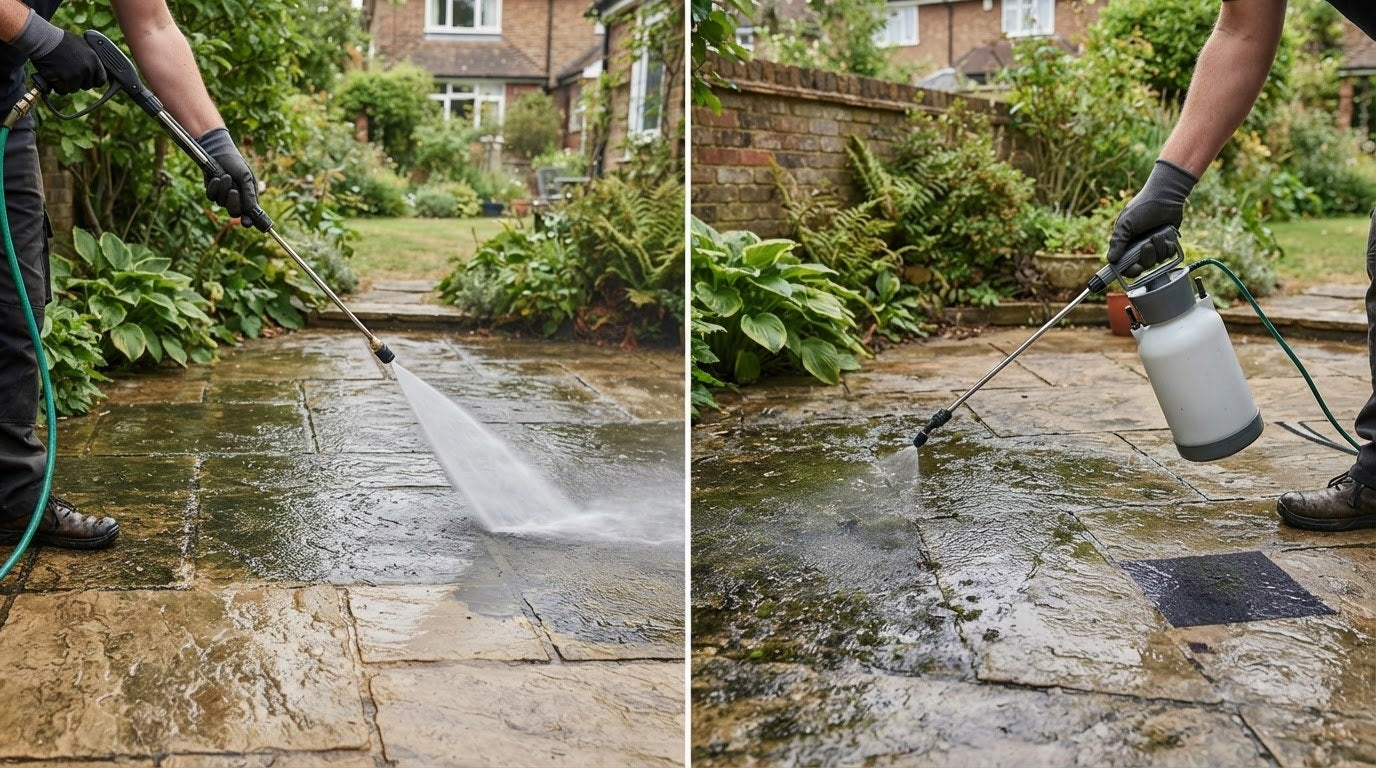
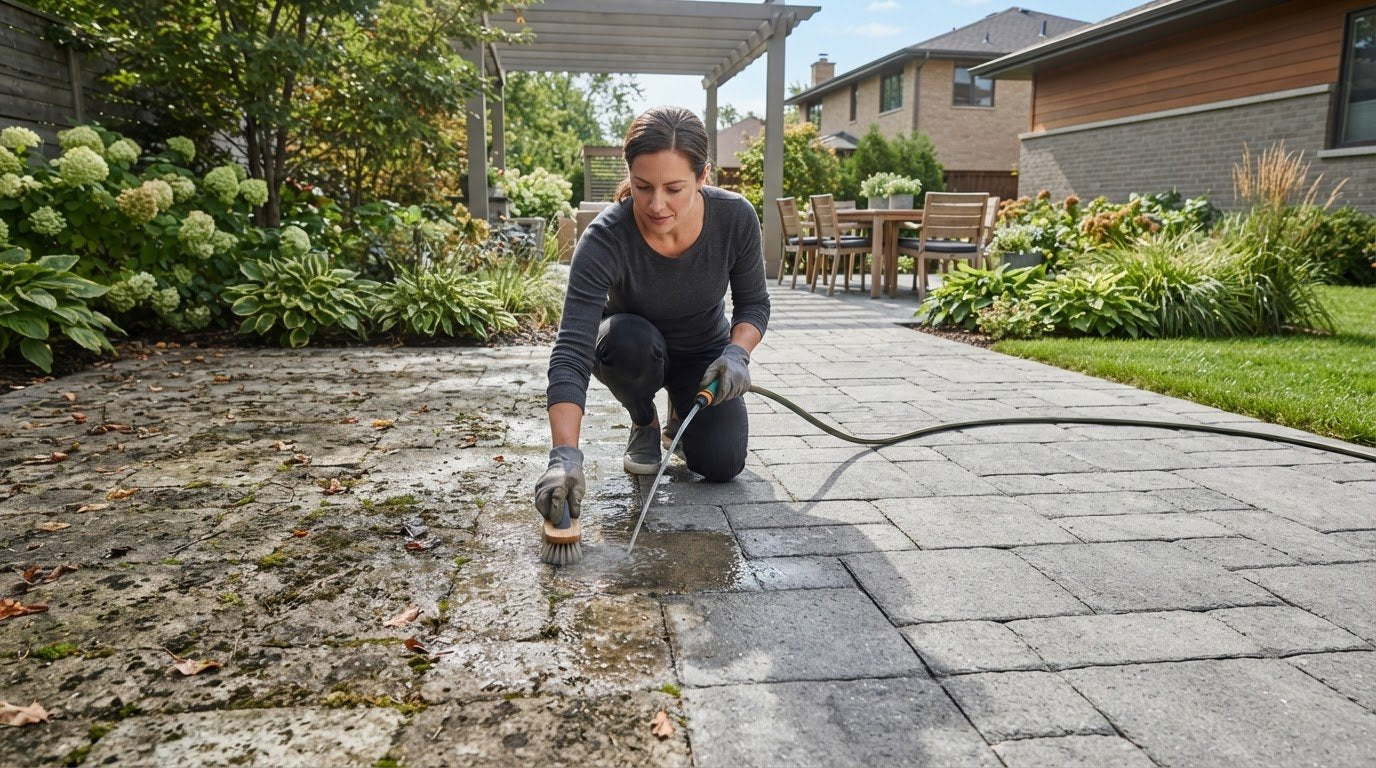
Could the wrong cleaner do more harm than the stain? Black spots, green growth, and pale chalky marks can all make Cambridge Pavingstones look neglected, but they may have different causes and need different approaches. Cambridge Armortec Cleaning starts with identifying the mark and checking Cambridge’s guidance for your specific paver, not simply choosing a treatment because it’s labelled for patios.
It’s understandable to reach for a pressure washer or a strong cleaner when grime won’t budge. But a treatment that isn’t suited to the surface, or washing with too much force, can leave an unwanted result. Start gently and confirm compatibility before applying anything. This guide explains how to distinguish likely organic growth, efflorescence, and general dirt, then choose a suitable cleaning approach. You’ll also learn when basic cleaning may be enough, when a targeted product could help, and how to use Cambridge’s current guidance and the product label to decide what to do next.
Key Takeaways
- For Cambridge Armortec Cleaning, identify the paver surface and likely stain before choosing a treatment.
- Black, green, and white marks can have different causes, so don’t assume one cleaner will suit them all.
- Start by removing loose debris, then use the gentlest method consistent with Cambridge’s guidance.
- Check the cleaner label for surface compatibility and follow its directions before treating the pavers.
- Keep bluestone cleaners separate from ArmorTec options unless the label or manufacturer confirms compatibility.
Cambridge ArmorTec Cleaning: Identify the Paver and the Stain First
Before choosing a cleaner, confirm what you’re cleaning. ArmorTec is Cambridge Pavingstones’ branded paving surface, but don’t infer the exact composition of a particular paver from the brand name alone. Check the product information or ask Cambridge for guidance. For general background, this overview of concrete pavers explains common paver types, but it can’t identify your specific product.
Next, look at the mark and where it appears. Cambridge Armortec Cleaning is easier to approach carefully when you distinguish loose dirt from possible organic growth or efflorescence. Color and location can provide clues, but they don’t confirm the cause. Marks that look similar may need different treatment, so don’t choose a cleaner based on appearance alone.
How to tell routine grime, organic growth, and efflorescence apart
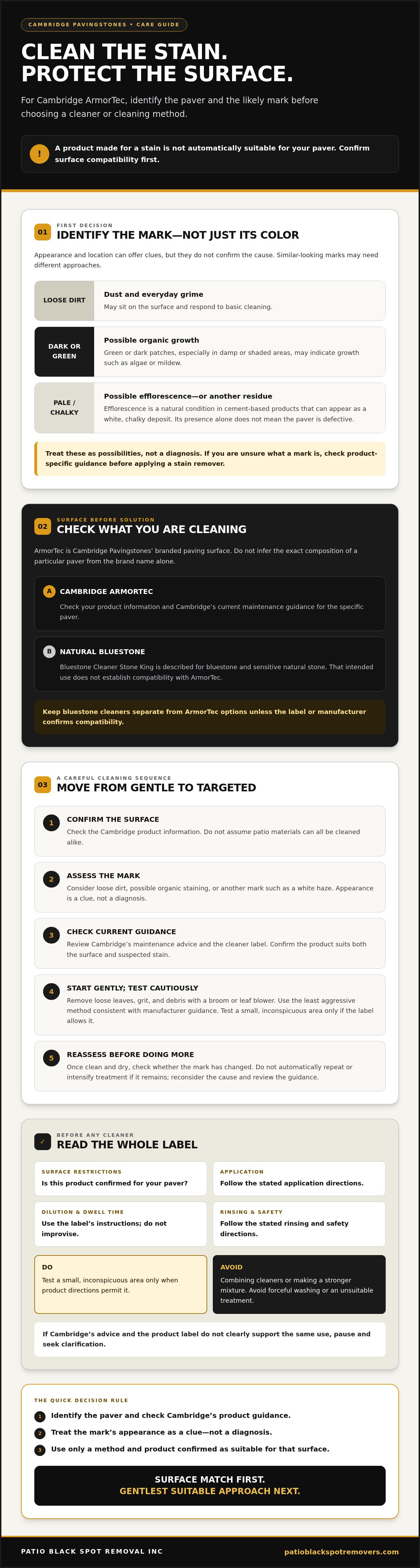
Loose dust and everyday grime may sit on the surface and respond to basic cleaning. Green or dark patches, especially in damp or shaded areas, may indicate organic growth such as algae or mildew. These marks can call for a different approach. A pale, chalky haze may be efflorescence, though other residues can also look white. Treat these descriptions as possibilities, not a diagnosis. Compare the mark with Cambridge’s current maintenance guidance before choosing a product.
Efflorescence is a natural condition in cement-based products that can appear as a white, chalky deposit on the surface. Its presence alone doesn’t mean the paver is defective. If you’re unsure whether a white mark is efflorescence or another residue, seek product-specific guidance rather than applying a stain remover by guesswork.
Why a bluestone cleaner may not be the automatic choice
Natural bluestone and Cambridge ArmorTec pavers shouldn’t be treated as interchangeable surfaces. Bluestone Cleaner Stone King is described for bluestone and sensitive natural stone. That intended use doesn’t establish compatibility with ArmorTec. Confirm your paver’s material, then check the cleaner label and Cambridge’s guidance before applying it. If neither source confirms the match, don’t assume the product is suitable.
This check helps avoid a common mismatch: choosing a treatment because it addresses the stain while overlooking whether it’s appropriate for the paving surface. Identify both the material and the likely cause before moving on to a cleaning method.
How to Clean Cambridge ArmorTec Pavers Without Guesswork
A simple sequence can help prevent a stain from becoming a surface problem. For Cambridge Armortec Cleaning, move from identifying the paver and mark to gentle cleaning, and only then consider a targeted treatment. First clear loose leaves, grit, and other debris with a broom or leaf blower. For general background, the Federal Highway Administration’s guide to routine maintenance for interlocking concrete pavement offers broader maintenance context. Cambridge’s guidance should take priority for its own paving products.
- 1. Confirm the surface. Check your Cambridge product information so you’re following advice for the specific paver, rather than assuming all patio materials can be cleaned alike.
- 2. Assess the mark. Consider whether it appears to be loose dirt, possible organic staining, or something else, such as a white haze. Appearance is a clue, not a diagnosis.
- 3. Check current guidance. Review Cambridge Pavingstones’ maintenance advice and the cleaner label. Confirm the product is suitable for the surface and suspected stain before using it.
- 4. Start gently and test cautiously. Use the least aggressive method consistent with manufacturer guidance. If the label allows a test, try the product on a small, inconspicuous area first and follow its directions exactly.
- 5. Reassess before doing more. Once the area is clean and dry, check whether the mark has changed. Don’t repeat or intensify treatment automatically if it remains. Reconsider the likely cause and review the guidance.
What to do before applying any patio cleaner
Read the full label, including surface restrictions and instructions for application, dilution, dwell time, rinsing, and safety. Follow the directions provided; don’t combine cleaners or improvise a stronger mixture. A test patch can reveal an unwanted surface response before you treat a larger area, but only test if the product directions permit it. If Cambridge’s advice and the label don’t clearly support the same use, pause and seek clarification.
Routine washing is intended for everyday surface dirt. A persistent dark or green mark may need a treatment designed for the suspected stain, but only if that product is also compatible with the paver. Cambridge’s spring-cleaning guidance mentions washing with a pressure washer on a low setting. Treat that as seasonal advice, not a universal instruction for every stain or situation. Check Cambridge’s current instructions before using pressure, since forceful washing may affect the surface or joint sand.
When a targeted treatment or specialist advice may be needed
If suspected organic staining remains after gentle cleaning, consider a targeted product only after confirming its intended use and compatibility with the surface. A white haze may be efflorescence rather than ordinary grime, so consult Cambridge’s guidance before treating it. If you’re still unsure about the material or stain, ask Cambridge or a qualified paving professional before applying chemicals or increasing cleaning force. For general stone-care product information, visit outdoor stone cleaning treatments, then verify that any product you’re considering is suitable for your pavers.
Compare Cleaning Options for Cambridge ArmorTec and Bluestone
The right patio cleaner depends on both the confirmed surface and the likely stain. A light layer of dirt may need no more than debris removal, while a stubborn mark may call for a targeted treatment. Neither case makes a bluestone cleaner an automatic choice for Cambridge ArmorTec. Compare the cleaning option with the paving material, then check the manufacturer’s guidance and the product label before proceeding.
| Cleaning option | Best suited to | Compatibility check |
|---|---|---|
| Loose-debris removal | Leaves, dust, and grit sitting on the surface | Use a broom or leaf blower appropriate for the area; avoid tools that could scratch or disturb the pavers. |
| Routine washing | Ordinary surface dirt after debris is cleared | Follow current Cambridge guidance for the specific paver. Use only an approved washing method and take care around the joints. |
| Targeted cleaner | A persistent mark that’s been identified as a particular stain type | Check that the label supports both the suspected stain and the confirmed paving material. Follow its directions. |
| Bluestone cleaner | Bluestone and sensitive natural stone, as described for Stone King | Don’t assume it suits ArmorTec. Confirm the paver material and verify compatibility with the label or manufacturer first. |
Routine cleaning versus a stain-specific treatment
Sweeping or manufacturer-approved washing may be enough for loose dirt and general grime. The Federal Highway Administration PICP Maintenance Guide provides broader reference material on maintaining interlocking concrete pavement, but Cambridge’s product-specific instructions should guide care of Cambridge pavers.
A targeted cleaner is a separate step, not simply a stronger version of routine washing. Consider one only after identifying the likely stain and confirming the product is labelled for the surface. For example, a cleaner intended for organic marks shouldn’t be treated as a universal solution for white haze or unrelated residue. Results can vary, so don’t assume a treatment will completely remove a mark.
When a bluestone cleaner is the right match
Bluestone Cleaner Stone King is described for bluestone and sensitive natural stone. That makes confirmed bluestone a relevant surface to consider, but it doesn’t establish that the product is suitable for Cambridge ArmorTec. If you have Cambridge pavers, check the product information to confirm the material and ask the manufacturer or product provider for guidance if compatibility isn’t clear. Choose based on verified fit, not a similar-looking stain or a broad “patio cleaner” description.
Use This Buyer’s Checklist Before Choosing a Cambridge Paver Cleaner
A cleaner can be designed for a particular stain and still be unsuitable for your paving. Before buying, compare the product’s stated use with the confirmed material and the mark you’re trying to treat. For Cambridge Armortec Cleaning, a quick label check can help you avoid choosing by brand name, stain color, or a broad “patio cleaner” description alone.
Questions to ask before buying a patio cleaner
- Have I confirmed the paving material? Check your Cambridge product information. Don’t assume a cleaner for natural stone is also suitable for concrete pavingstones.
- Does the label allow use on this surface? Look for the confirmed material by name or clear wording that explicitly permits its use. If the label excludes the surface, don’t apply the product.
- Have I identified the likely stain? Consider whether the mark appears to be ordinary dirt, possible organic growth, efflorescence, or something else. Choose a targeted cleaner only if its stated purpose matches the likely stain.
- Are the directions clear? Before purchase, check the label for application, dilution, dwell-time, rinsing, and safety instructions. Follow only what the label states; don’t guess at missing steps or modify the directions.
- Have I checked the surroundings? Review label instructions for precautions around nearby plants, drainage, and other surfaces. Confirm any restrictions before bringing the product to the patio.
- Does Cambridge’s guidance support this choice? Compare the product label with current Cambridge Pavingstones maintenance advice. If they don’t clearly align, pause and ask for guidance.
When not to buy or apply a product yet
Hold off if you can’t confirm what the pavers are made of, the label doesn’t name or allow the surface, or the directions leave you unsure how to use the cleaner safely. A product described for natural stone shouldn’t be treated as a match for ArmorTec concrete pavers without verified compatibility.
Pause, too, if the mark could be efflorescence or surface damage rather than a stain. Applying a stain remover without knowing what you’re treating may be the wrong next step. Check Cambridge’s guidance, then contact the manufacturer or product supplier if the surface, mark, or product suitability remains unclear.
Once you’ve confirmed the stain and paving material, you can explore outdoor stone cleaning products and compare their stated uses with your checklist before choosing.
Choose a Surface-Matched Cleaner and Plan Your Next Step
The safest choice isn’t simply the cleaner that mentions patios or the stain you can see. Confirm the paving material, identify the likely cause of the mark, check current Cambridge Pavingstones guidance, and choose a product only if its label supports use on that surface. That’s the practical approach to Cambridge Armortec Cleaning, especially when a treatment is intended for a different paving material.
Match the products to their stated uses
Patio Black Spot Remover is described for black spots and organic staining on natural stone and paving slabs. That stated use doesn’t confirm compatibility with Cambridge ArmorTec. Before considering it for these pavers, check the current product label and Cambridge’s guidance. If they don’t confirm it’s suitable, don’t apply it based on the stain’s color alone.
Bluestone Cleaner Stone King is described for bluestone and sensitive natural stone. It isn’t a default option for ArmorTec either. Confirm the paving material first, then verify that the cleaner’s label allows use on it. Neither product should be treated as a guaranteed fix for every mark or every Cambridge paver.
Take the next step with confidence
Use the information you’ve gathered about the stain and surface to compare your options with current product directions. If a mark might be efflorescence or surface damage, or the paver material is uncertain, pause before applying a targeted cleaner. Check with Cambridge or ask the product supplier for guidance when compatibility isn’t clear.
Once you’ve confirmed the match, review the label for the full application and safety directions before use. For product details, find the right outdoor stone cleaner, then check whether its stated use fits your confirmed surface and stain.
Make Your Next Cleaning Choice With Confidence
Good Cambridge Armortec Cleaning starts with two checks: confirm the paver material and identify the likely stain. Then follow Cambridge’s current care guidance and choose a treatment only when its label confirms it’s suitable for both. A mark’s color alone isn’t enough to determine the right cleaner.
Patio Black Spot Remover is described for black spots and organic staining on natural stone and paving slabs. Bluestone Cleaner Stone King is described for bluestone and sensitive natural stone. Neither description confirms compatibility with Cambridge ArmorTec, so check the current product label or ask for guidance before applying either to these pavers.
Compare the surface, stain, and product directions before treating the area. If you’re considering a cleaner, find the right outdoor stone cleaner and review its stated use. A careful match helps you tackle visible marks without guessing.
Frequently Asked Questions
Can I use a bluestone cleaner on Cambridge ArmorTec pavers?
Only if the product label or Cambridge confirms it’s compatible with your specific paver. Bluestone Cleaner Stone King is described for bluestone and sensitive natural stone, which doesn’t establish suitability for Cambridge ArmorTec. These surfaces shouldn’t be assumed interchangeable. Check the paving material and current product directions first. If compatibility isn’t clear, pause and ask the product supplier or Cambridge for guidance rather than testing the cleaner on the patio.
How do I clean Cambridge ArmorTec pavers safely?
Start by confirming the paver type and likely cause of the mark, then follow current Cambridge maintenance advice. Remove loose leaves and grit before washing, and begin with the least aggressive method the guidance allows. For Cambridge Armortec Cleaning, don’t choose a targeted product until its label confirms it’s suitable for both the surface and suspected stain. If the mark remains, reassess its cause instead of automatically using a stronger treatment.
What causes white haze on Cambridge pavingstones?
A white or chalky haze may be efflorescence, a natural condition in cement-based products, but appearance alone can’t confirm the cause. Other residues may also look pale. Check Cambridge’s current guidance before treating the mark as ordinary grime or applying a stain remover. If you’re uncertain whether the haze is efflorescence, residue, or a surface issue, ask Cambridge or a qualified paving professional for advice before choosing a treatment.
Can I pressure wash Cambridge ArmorTec pavers?
Use a pressure washer only if Cambridge’s current instructions for your pavers allow it, and follow the recommended settings and method. Cambridge’s spring-cleaning guidance mentions washing with a pressure washer on a low setting, but that seasonal advice may not fit every stain or situation. Excessive pressure can damage pavers or dislodge joint sand. If the guidance is unclear, choose a gentler approved method and avoid directing force at the joints.
What is the difference between dirt, algae, and efflorescence on pavers?
Dirt is loose or general surface grime and may lift with routine cleaning. Green patches, or dark growth in damp areas, could be algae or other organic growth, which may need a different approach. Efflorescence often appears as a white, chalky deposit on cement-based products. These are visual clues, not a certain diagnosis. Check the surface and Cambridge guidance before selecting a cleaner, especially if the mark doesn’t respond to gentle washing.
Will a patio cleaner remove black spots from Cambridge pavers?
It depends on what caused the spots and whether the cleaner is compatible with the pavers. Patio Black Spot Remover is described for black spots and organic staining on natural stone and paving slabs, but that doesn’t confirm it’s suitable for Cambridge ArmorTec. Check the current label and Cambridge guidance before use. Don’t assume every black mark is organic staining or expect a particular result without confirming the product’s stated use.
How can I check whether a cleaner is compatible with my pavers?
Confirm the paving material from your product information, then read the cleaner label for that surface and the stain it’s intended to treat. Review the stated application, dilution, dwell time, rinsing, and safety directions, along with any restrictions for nearby plants or drainage. Compare the label with Cambridge’s current maintenance guidance. If either source is unclear or conflicts with the other, don’t apply the cleaner until you’ve asked for product or manufacturer advice.
For product details and stone-care advice, visit Patio Black Spot Removal INC's online shop, then check the label and Cambridge’s guidance to confirm a product suits your pavers.